
A free setting can take your debit fees from around 1.5% to under 0.8% a tap. Here's what least cost routing is, why it matters, and how to check yours.


There's a setting buried in almost every payment terminal, that decides how much you pay every time a customer taps. Most merchants have never been shown it. Most have never been asked about it. And for many, it's been left exactly where the factory put it, on the more expensive option.
It's called least cost routing (LCR) and it's free to turn on. And for a lot of merchants, it's the clearest gap between what they're paying and what they could be.
This isn't a pitch. It's something a good payments partner should have walked you through on day one. So here's the explanation, in plain terms.
What actually happens when a customer taps
Most debit cards in Australia carry two networks: EFTPOS on one side, Visa or Mastercard on the other. When a customer taps, your terminal has to choose which of those two networks to send the transaction down. Both will complete the sale. They just charge different amounts to do it.
If left on default, the overwhelming majority of terminals route every tap through Visa or Mastercard, typically the more expensive of the two. Not because it's the right call for your business. Because it's the default setting on the terminal, and no one changed it.
So the cheaper network sits there, available on the same card, and gets passed over. On every eligible transaction. All day.
What least cost routing does instead
Least cost routing reads each dual-network debit tap and sends it down the cheapest available network automatically. Nothing changes at the terminal. Your staff do nothing differently. The customer notices nothing. The only thing that moves is where the cost lands, and it lands lower.
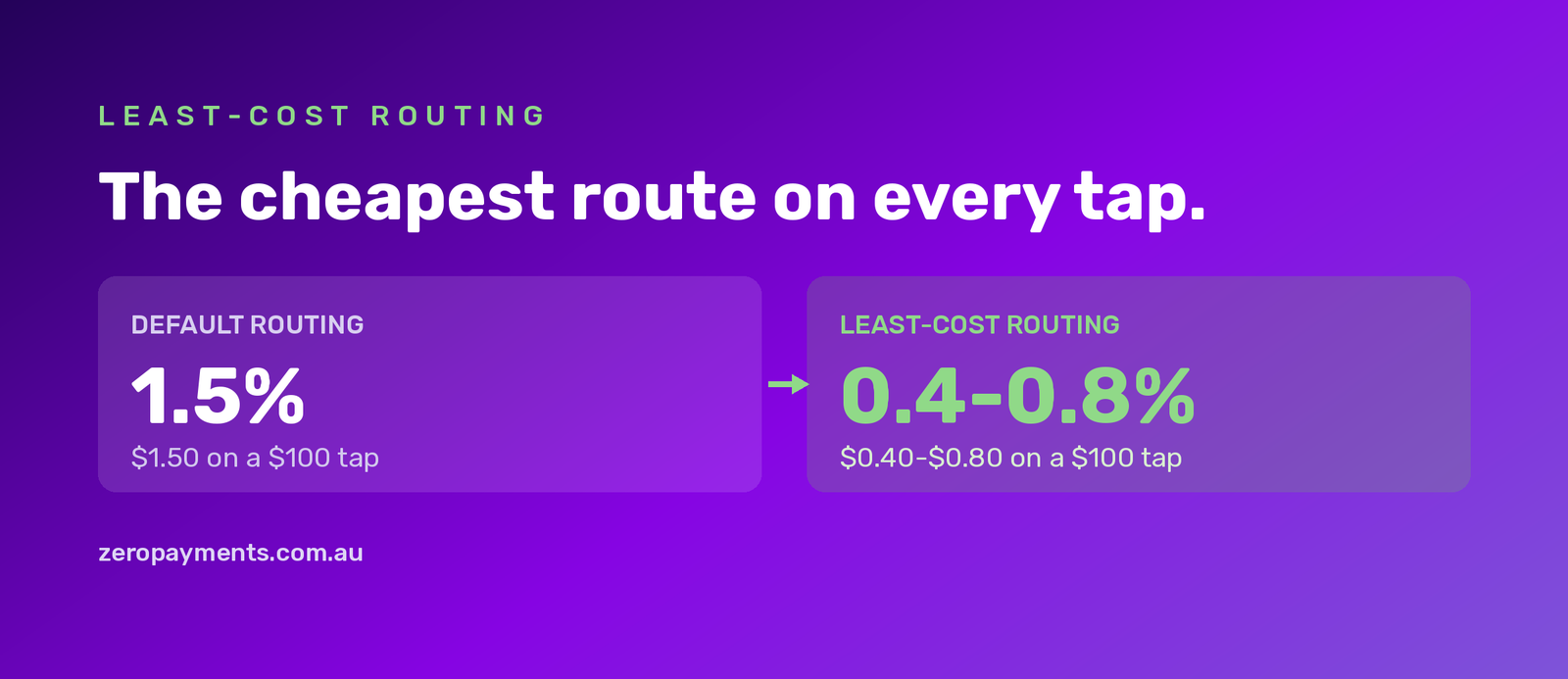
To demonstrate with rough numbers: a default-routed debit tap often costs in the order of 1.5%. The same tap, least cost routed, frequently sits between 0.4% and 0.8%. On a $100 sale, that's the difference between paying around $1.50 and paying somewhere closer to 40 to 80 cents.
One caveat though: LCR applies to dual-network debit cards. Credit cards, international cards and American Express always route through the card scheme's network, so they're not part of this. The saving is real, but it's specific to the debit traffic that makes up a large share of most merchants' volume.
Why this is worth more than it looks
The instinct is to treat a fraction of a percent as rounding. However, across a year of trade, it stops being rounding and becomes a line on the P&L.
Further every year
$3,384
A merchant on $30k/month can move from roughly $450/mo in fees to about $168/mo. Same trade, cheaper route, money back to your margin.
Your own figure will differ. It depends on your card mix and your volume, which is why a proper comparison is worth doing rather than guessing. But the shape of the saving is consistent: same trade, cheaper route, money back to your margin.
Routing is the first lever, not the only one
Switching on LCR is the fastest win, but it's not the whole story. The merchants who have their cost of acceptance genuinely under control tend to consider four things:
- 01
Enable LCR
Free to switch on. Just ask your payment provider. That's the starting point.
- 02
Move to interchange++ pricing
Pay the actual network cost rather than a blended margin set by a provider. At volume it's almost always cheaper, and when the networks cut their rates, the cut flows directly to you instead of being absorbed.
- 03
Buy terminals outright
Renting at $30–50 a month is a quiet, permanent cost line. Bought outright, most terminals pay for themselves inside a year.
- 04
Get a competing quote
It's the least technical move and often the most powerful. Most providers will drop a rate 0.3–0.5% within a week once they know you're comparing. Knowing your real number is the leverage.
None of these are clever tricks. They're just the levers that exist once someone shows you where they are.
Where Zero Payments stands on this
We've enabled LCR for every eligible merchant since we started. We didn't wait to be asked, because we don't think it should be a conversation a merchant has to initiate. It's table stakes, and we'd rather spend the conversation on the structure around it.
We care about that difference. Most providers hand you a terminal and a rate. We'd rather design the structure first, routing, pricing model, hardware, card mix, and then find the right fit inside it. Our pricing is interchange++ by default, which means you see every cost layer and rate cuts reach you instead of stopping at a margin. And because we're backed by Tyro, the reliability question is settled: 100% card-acceptance uptime across the last four quarters, a figure the RBA requires us to publish and most providers quietly don't.
Calm, clear, and on your side. That's the job.
The honest next step
If you've read this far, you can already tell whether your routing has ever been looked at. If you're not sure, that uncertainty is the answer, and it's worth fifteen minutes to close.
We'll review your current setup: pricing model, card mix, routing configuration. Then we'll show you exactly what you should be paying, and you decide what to do with that. No obligation, no lock-in.
Least cost routing applies to dual-network debit cards (EFTPOS + Visa/Mastercard). Credit, international and American Express transactions always route through the card-scheme network. Savings figures are illustrative and depend on your card mix and processing volume. General information only, not legal or financial advice.